The Underground Kingdom of AlSahraa' (Aka. "The Combs")
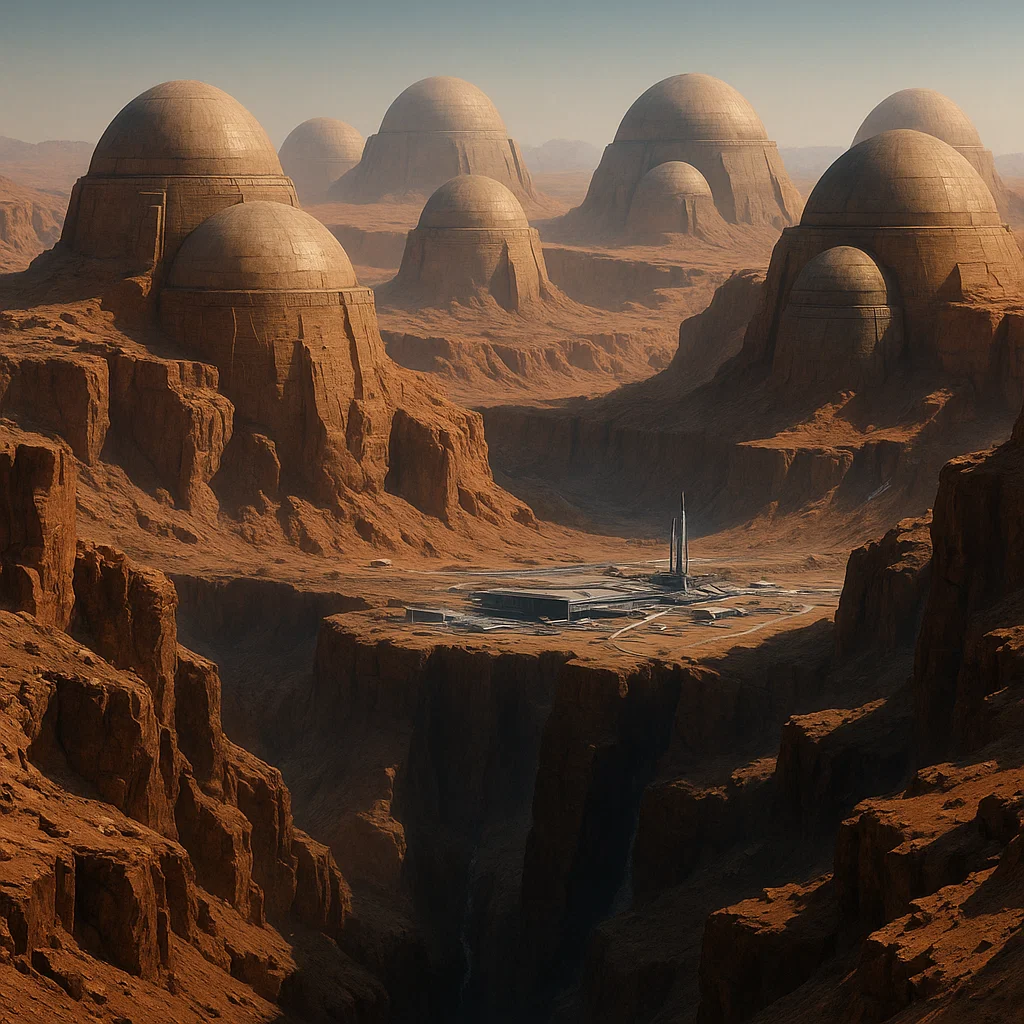
History
Founding
When AlSahraa' arrived at Samūm, the colony ship was in a state of panic. The orbital surveys of the planet indicated no surface water at all, in spite of an aerial humidity level that was believed to require at least minor lakes and seas. Furthermore it was clear that with the planet's high gravity, the colony ship once landed would never fly again.
Over the next decade scientists aboard madly scrambled to identify pockets of water for the growing population aboard, but only enough resources for some 10% of the people were found. Those brave enough to leave began mining the planet's mineral resources and established several small cities. In 2190, Yakub Bukhtīshūʿ, a child-prodigy, came up with an idea for tuning output of the engines of the colony ship to drill into the rock of Samūm's surface. Although scientists aboard the AlSahraa' believed it would not work, but the boy proved that it would. The ship landed in the region now known as Quoath and engines were removed to begin hollowing out a giant subterranean city, now known as "The Combs" after the ancient roman catacombs.
The colony ship itself was lowered into the central comb, and became the core of the new underground civilization.
The Al-Sahra’i Royal Family
The Al-Sahra’i Royal Family are direct decedents of the original financiers of the AlSahraa' mission. The process by which the family also came to be viewed as leaders and monarchs is not clear Because by the royal family is also the inherited owner of all ship resources, including the ship itself; the Combs, created by the ship's engines, became a defacto extension of the AlSahra'i kingdom. As the Combs were settled, the people living there became subjects of the King.
(Editor's note: The story of how the AlSahra'i family came to power was possibly obscured intentionally, as some have suggested, but even my friend who is part of the royal family claims her father did not know the history of how they became monarchs on AlSahra'i, and I believe her. They believe they lead now by right of ownership. The actual ownership is said to be distributed through the living descendants, but the executor of that power is the acting monarch)
Population
1.5 million people live in the Combs (2290 figure). It is a busy place, crowded with mixed marketplaces, residential streets and gardens built in tunnels and on the walls of the vast main chambers as the city has expanded outward and downward.
-
Working Adults: 400,000 (26%)
- Individuals employed in the various sectors as described below.
-
Unemployed Adults: (0.8%) - Estimated Population: 12,000
- A low unemployment rate due to the highly structured economy and necessity for labor, 3% unemployment: - *400,000 3% = 12,000** unemployed adults.
-
Higher Education and Advanced Schooling (Majority ages 18-24): (6%) - Estimated Population: 90,000
- Young adults engaged in higher education, vocational training, and specialized studies that prepare them for more advanced roles in society. This group might also include apprenticeships and early career starts in technical and scientific fields.
-
Off-planet Transient Workers and Tourists (6%) - Estimated Population: 90,000
- Transient population not included in main population count, includes space nomads, visiting surface dwellers and crews from spaceships on shore leave.
-
Homemakers with Children Under 12: (21%) - Estimated Popluation: 320,000
- Homemaker population includes parents (typically one per household) managing young children and household affairs, and given the cultural emphasis on family, approximately 50% of adults are in this role:
-
Children/Youth: (30%) - Estimated Population: 450,000
- Population in the Combs is growing about 4%/year. Life expectancy is about 100.
- General Upbringing Trends: Young children (age 0 to 6) usually live at home with parents: It is very rare that children are in daycare or similar, single-parent homes are also very rare in this culture. Most children this age are raised in the homes. Children age 6-12 similarly typically stay at home with parents and home-educated or in small, community-based schools. Youth aged 12 to 18 are usually educated via semi-structured internships.
- Elderly Population: (10%) Estimated Population: 150,000
- Elderly people usually live with extended family and assist in child-rearing where they can. As familes outgrow housing units, typically at least one sibling will stay in the family home. Building new dwelling places is limited to large, government-led projects. Most families tend to expand existing dwellings to add new rooms and additions rather than leave and find new homes.
-
Economy
(workforce size and statistics based on 2290 census figures)
- Mining and Resource Extraction:
- Workforce size: 112,500 (7.5%)
Mining is the backbone of the Combs economy, providing raw materials for shipbuilding and generating trade goods for export. This sector includes deep-core mining, surface extraction, and mineral processing facilities.
- Manufacturing and Materials Processing:
- Workforce size: 93,750 (6.25%)
This sector refines raw materials from mining into usable goods for shipbuilding and export. It includes metal refining, composite material production, and manufacturing of components for various industries.
- Automated Systems and Robotics:
- Workforce size: 46,875 (3.125%)
Involves the design, production, and maintenance of robotics and AI systems used across industries, including shipbuilding and mining.
- Logistics and Transport:
- Workforce size: 46,875 (3.125%)
Ensures the smooth flow of goods, materials, and people within the Combs and to/from other planets. It includes space tug operators, drone logistics, and surface transport systems.
- Construction and Infrastructure Development:
- Workforce size: 65,625 (4.375%)
Focuses on mining out new living spaces, reinforcing structures, and developing infrastructure for a growing population, including power generation and environmental control systems.
- Agriculture and Hydroponics:
- Workforce size: 23,438 (1.5625%)
Focuses on highly efficient hydroponic farms and algae production to supplement imports and provide some degree of food security.
- Water Management and Recycling:
- Workforce size: 14,062 (0.9375%)
Manages the collection, purification, and recycling of water resources, ensuring sustainability on a desert world.
- Energy Production and Distribution: 23,438 (1.5625%)
Manages nuclear reactors, solar farms, and energy distribution networks that power the Combs and its industries.
- Research and Development:
- Workforce size: 37,500 (2.5%)
Focused on innovation across all sectors, including new mining techniques, improved manufacturing processes, and advanced ship designs.
- Government, Law, and Public Services:
- Workforce size: 28,125 (1.875%)
Includes the monarch and his family, the governing bodies of the Combs, and other essential public services such as waste management and environmental services not included below.
- Trade and Commerce:
- Workforce size: 234,375 (15.625%)
Includes retail, small businesses, entertainment, and trade-related activities that support the general population including legal, finance, telecommunications and IT.
- Specialized Skilled Trades and Artisans:
- Workforce size: 140,625 (9.375%)
Includes master craftsmen, artisans, and specialized skilled trades that do not fit into broader industrial sectors.
- Creative and Cultural Sector:
- Workforce size: 140,625 (9.375%)
Includes artists, writers, musicians, educators, historians, and those involved in preserving and developing the cultural heritage of the Combs.
- Healthcare and Social Services:
- Workforce size: 168,750 (11.25%)
Medical professionals, therapists, social workers, and caretakers who provide health and welfare services to the population.
- Security, Defense, and Law Enforcement:
- Workforce size: 112,500 (7.5%)
Includes police, defense forces, private security contractors, and related roles.
- Research and Academic Institutions:
- Workforce size: 196,875 (13.125%)
Researchers, academics, and staff associated with universities, think tanks, and other research institutions.
- Service Industry (Hospitality, Food Services, etc.):
- Workforce size: 168,750 (11.25%)
Covers hospitality, food services, entertainment, and retail.
- Environmental and Ecosystem Maintenance:
- Workforce size: 84,375 (5.625%)
Workers engaged in environmental monitoring, forestry, animal management, and maintaining the Comb’s ecological balance between mining, industry, and habitation.